Inside AI #1
Hey everyone,
Welcome to the first Inside AI newsletter. Every Friday I'll share what happened in AI this week, a couple of things you can try yourself, what I'm testing and learning, and some of the cool things I came across along the way.
This is for non-technical AI users out there that are using AI on real work every day and want to keep getting better at it. You don't need to know how to code or be super technical to do serious work with AI, and this newsletter is meant to show that while keeping you up to date with the rapidly changing world of AI.
Something of a wild week in the world of AI. A bit of uncertainty given the midterm election results and the stock market's response.
Also in here: an architect used AI to generate his house plans, three owners who pointed AI at their money, what's working (and not) in my own setup, and a stack of links for your weekend.
Let's dive into it.
What the midterms mean for AI
Democrats are projected to win both the House and the Senate. (A few races are still being counted, and the new Congress starts January 3.) I'm not here to talk politics, but AI was actually on the ballot a lot, so I had my research agents do some digging.
Rep. Yassamin Ansari (AZ) wants a pause on advanced AI and "a ban on artificial superintelligence" on day one. Bernie Sanders posted "NATIONAL DATA CENTER MORATORIUM NOW." There are already bills for both, but House Democratic leader Hakeem Jeffries said in October that he isn't ready to take a position on a ban, and the Senate version has zero cosponsors. So take it with a grain of salt. Sanders and Ansari
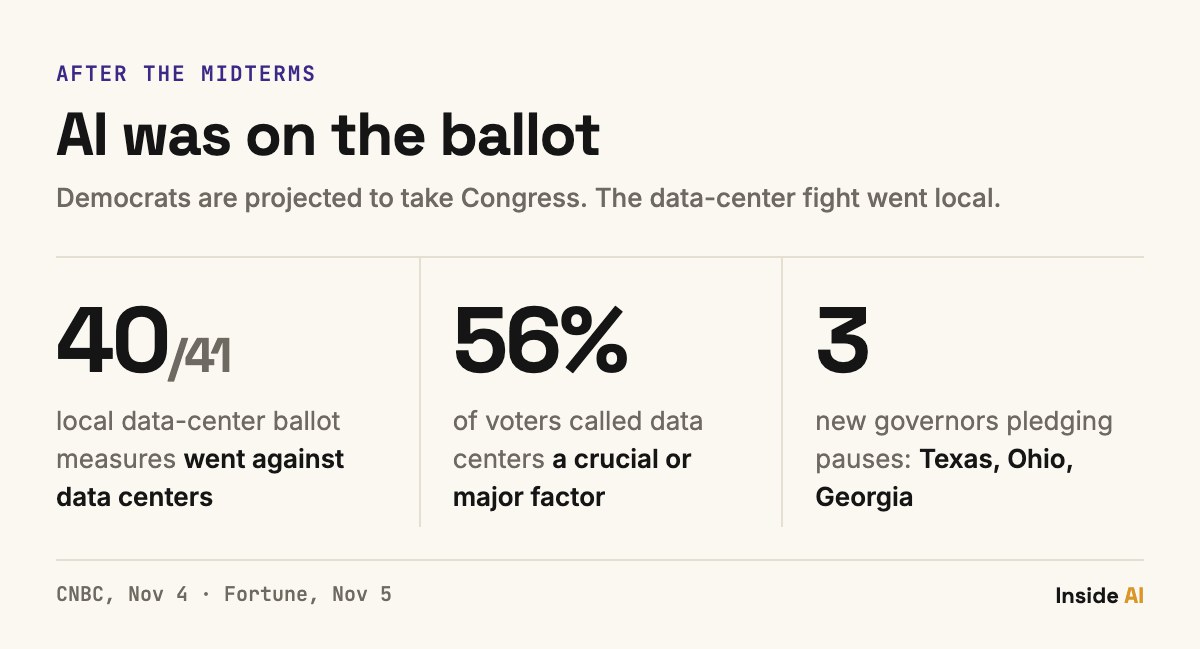
The real action was local. Voters weighed in on 41 data-center measures in 10 states and went against data centers in all but one. In CNBC's voter poll, 56% said data centers were a crucial or major factor in their vote. And three new governors, in Texas, Ohio and Georgia, have promised to slow them down. Governors control utility regulators and tax breaks, so that's where things matter more. CNBC · Fortune

The AI companies are paying attention to all this. OpenAI put out a "National Community Compact": it'll pay its own way on power and grid costs, publish each site's water and electricity use, and stop using NDAs with public officials. Basically: please don't take away our data centers. OpenAI's compact
Wall Street noticed too. On Wednesday stocks partied: the Dow jumped more than 1,500 points, its best day since April 2025. AI stocks sat it out (Nvidia down 3%, CoreWeave, which runs AI data centers, down almost 10%). On Thursday, everything gave it back and then some. The S&P 500 fell 4.4% and the Nasdaq 5.5%, the worst day for both since the April 2025 tariff shock, and more than $2 trillion came off the S&P 500. AI chip makers got hit hardest: AMD and Micron each fell more than 15%, Nvidia about 9%. The worry in the coverage: a Democratic Congress, new governors and local votes could slow down data center building, which has been the engine behind AI stocks. AP · CNBC · Fortune
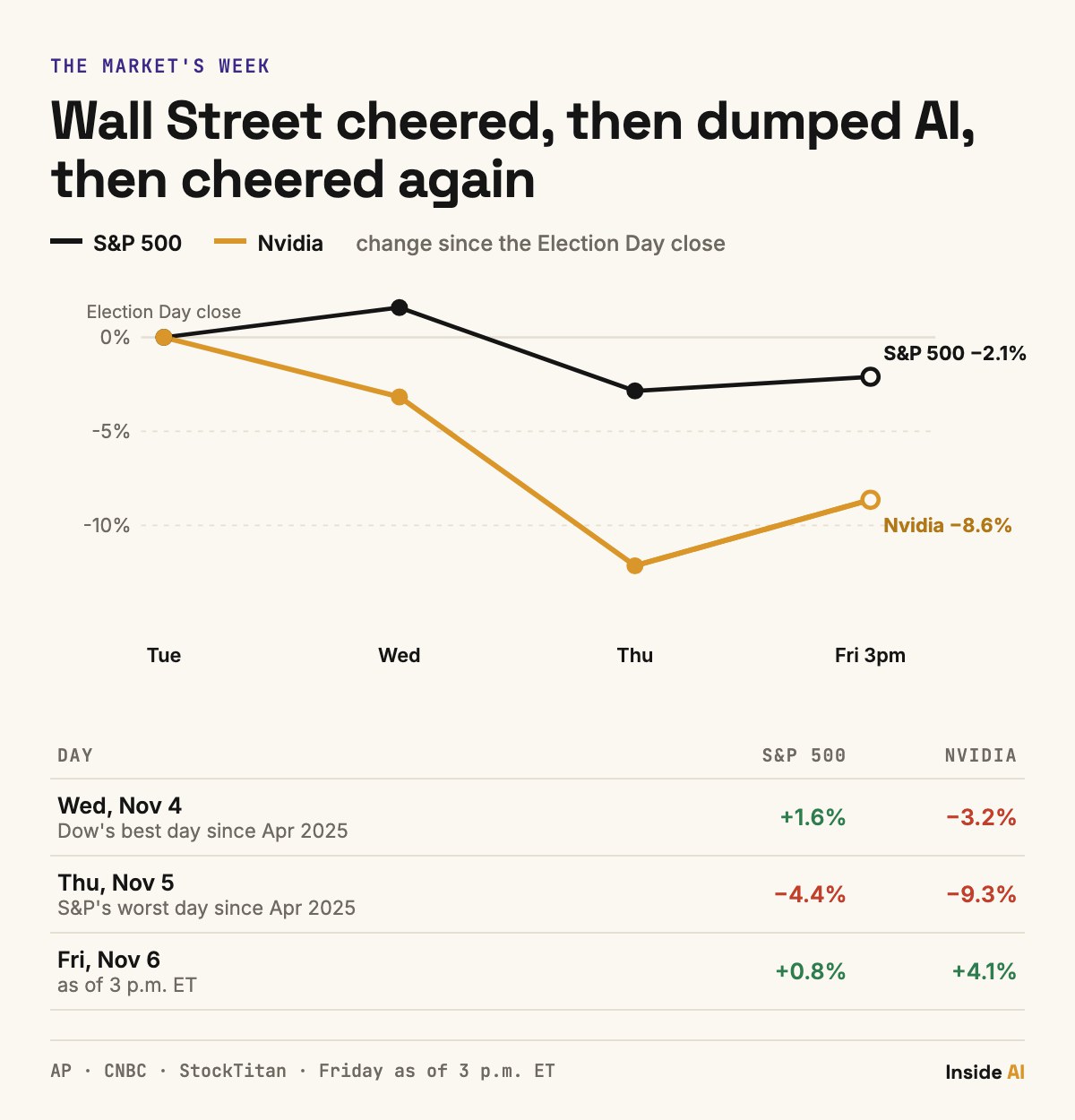
And on Friday, AI stocks bounced back. As of 3 p.m., Nvidia was up about 4% and the S&P 500 just under 1%. Even after the bounce, both are still below where they closed on Election Day.
I'm not a big market guy, but I think it's important to understand what's going on in Washington and on Main Street. The AI tools we use today aren't going anywhere next month, but I'll be paying close attention to what's going on and being said in the county and state I live in.
If you're curious what's going on in your town, give your AI of choice the following prompt:
I live in [your town and state]. Search the web and tell me, in plain English: who my local, state and federal officials are and what each one has said in public about AI or data centers, with a link; whether any data centers are planned or being built near me, and where they stand; and any upcoming votes or public meetings about them. If you can't find something, say so instead of guessing.
Click a couple of the links before you repeat anything at your Thanksgiving dinner table and end up with dressing on your face.
People doing real work with AI
I keep a running library of real ways regular people are using AI, pulled from what they've written or shared online. I'm at 183 use cases and counting, and each week I'll pull out a few. This week: an architect, and three owners who pointed AI at their money.
An architect made 13 AIs draw his house
Stephen Gallagher has been an architect since the 2000s. He handed his rough house sketches to thirteen AI models and asked each one for a full set of construction drawings. The winner, in his opinion: Claude Opus 5.5, good enough to support a permit application. (Nothing was actually submitted.)
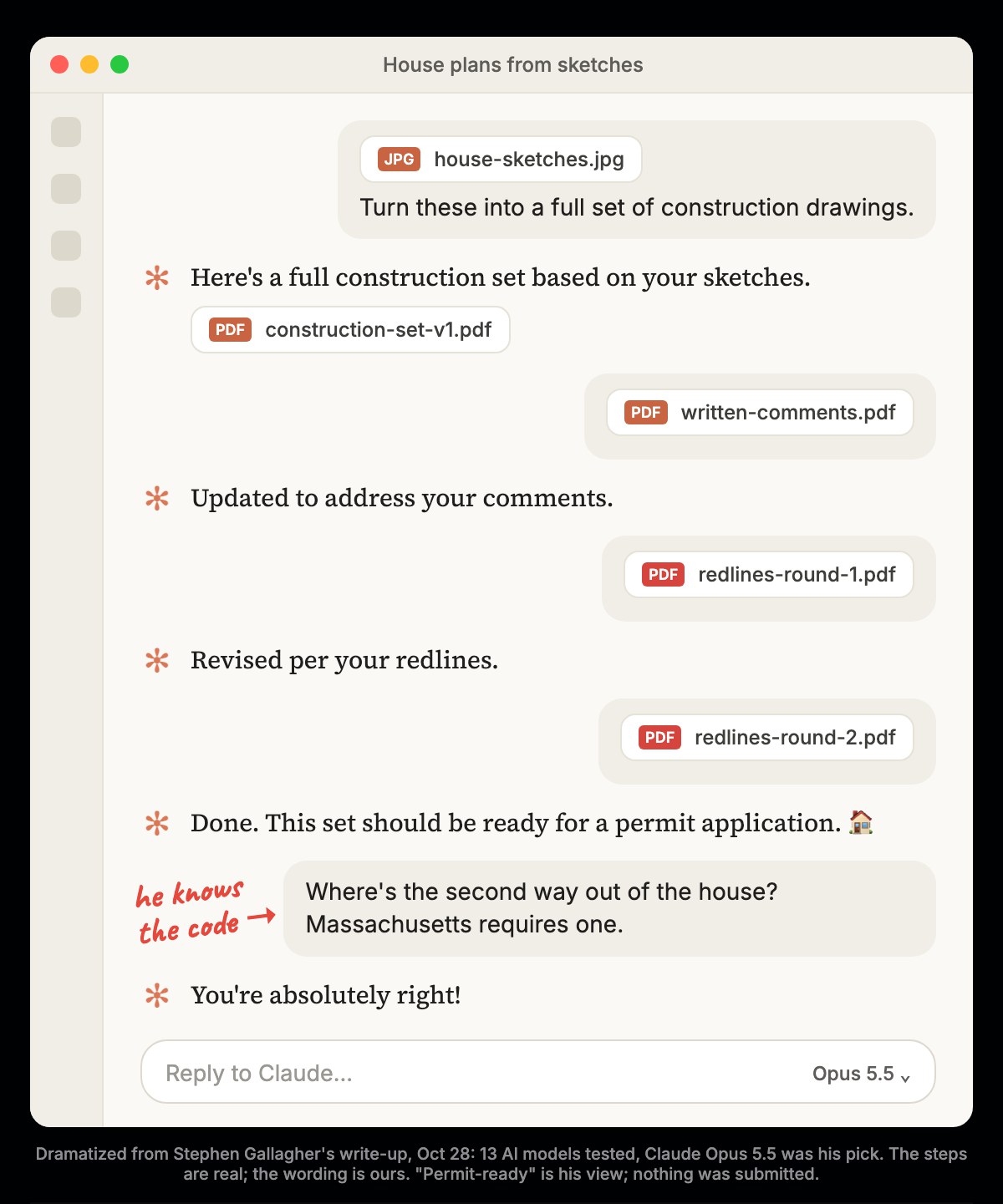
The fun part is how it got there. Opus didn't nail it alone. He gave it written comments and multiple rounds of redlines. Even then, it missed a second way out of the house that Massachusetts requires. Stephen caught it because he knows the code, but someone who didn't would've handed in plans with a real problem.
So a lot of the quality actually came from the expert, not the model. I think that is how we should be leveraging these models: let them draft, go through multiple rounds of reviews and revisions, then ship it.
Read Gallagher's full write-up
Three owners who pointed AI at the money
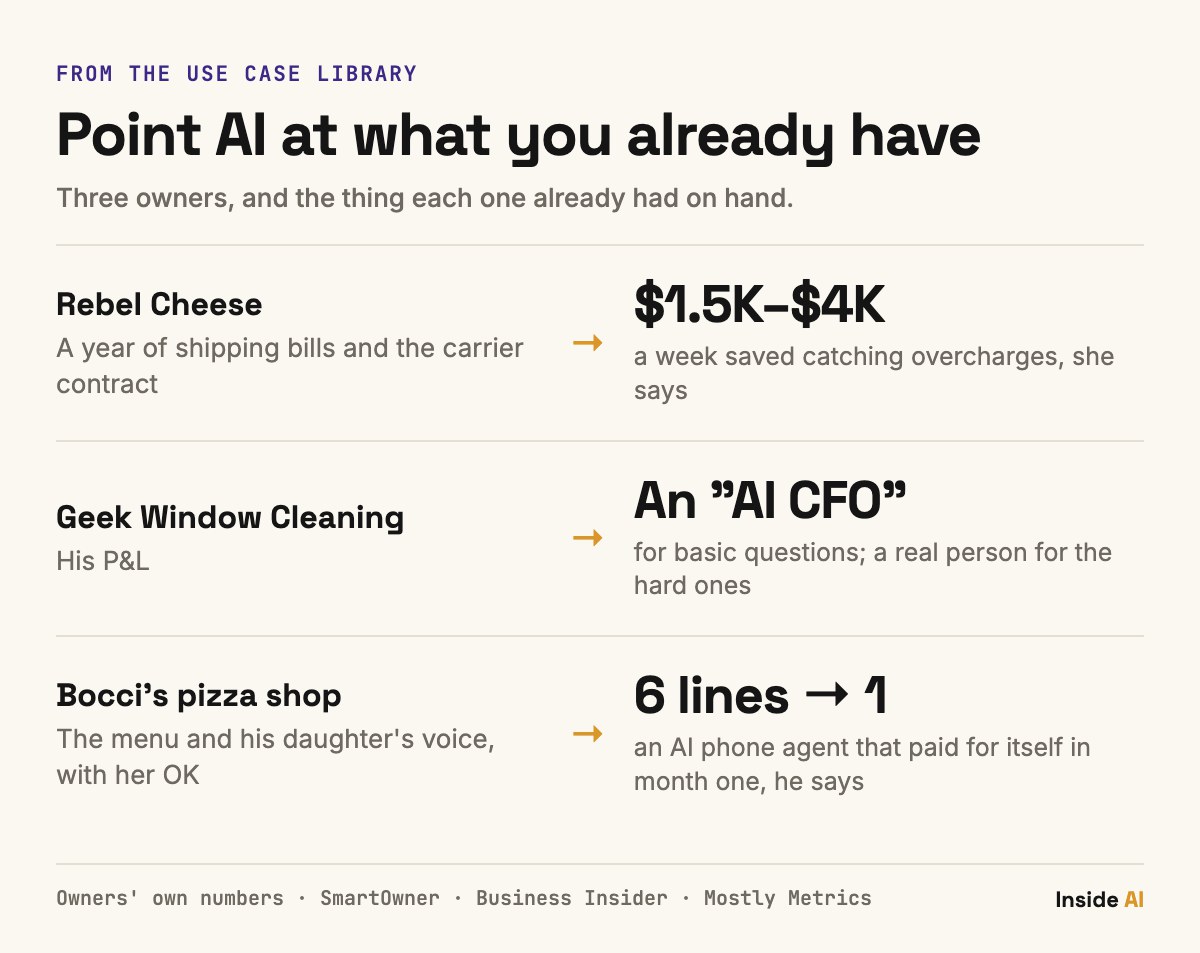
Rebel Cheese. Kirsten Maitland makes vegan cheese in Austin. She uploaded a year of shipping invoices plus her carrier contract to Claude and had it check every charge against the contract. Then she built a little web app in Manus that checks each week's invoice and turns overcharges into credit requests. She says it saves $1,500 to $4,000 a week, for about $200 a month in AI tools. That's a lot of cheese. Read the full story.
Do you ship stuff? Try this:
Attached are 12 months of shipping invoices and my carrier contract. Compare every charge to the contract terms. List each surcharge type, how often it appears, the contract clause it relies on, and any charge that doesn't match the contract, with the total amount by issue. Look for patterns, not just single errors.
Geek Window Cleaning. Kyle Ray runs a window-cleaning company in Austin and Houston. He feeds his P&L to ChatGPT and asks how to grow his margins. "It's just me," he told Business Insider. "I don't have a CFO or a CEO or a COO... but I can create ones in ChatGPT." The AI CFO gets the basic questions; a real person gets the hard ones. The story
Bocci's. Tony owns a pizza shop. A vendor spent eight hours in the shop, then trained an AI phone agent on his menu and on how his daughter answers calls, using her cloned voice (with her permission). It speaks 16 languages, cost $12,000 upfront plus $500 a month, and Tony says it paid for itself in the first month. Six phone lines down to one. The story
These are their stories and obviously I haven't seen their books. But I don't doubt them. Each one started with something they already had (a contract, a P&L, a menu), pointed AI at it, and worked to make things better.
Worked, testing, paused
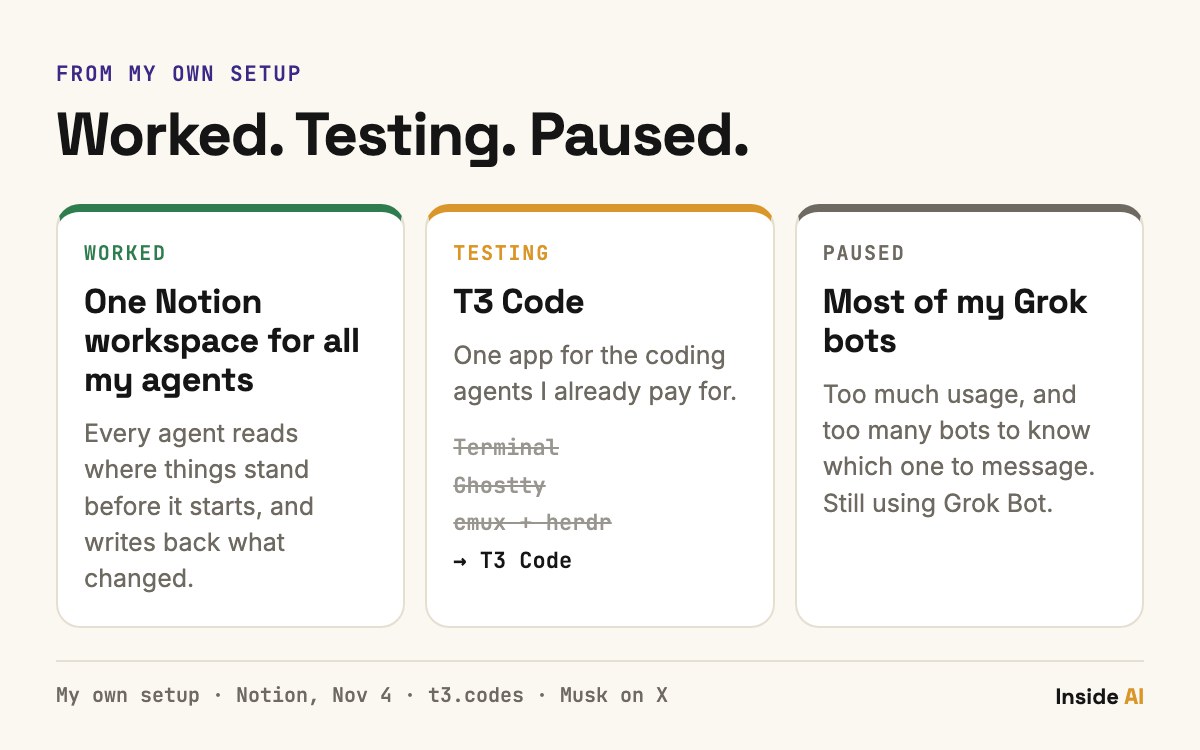
Here's what actually happened in my own setup this week: one thing that worked, one I'm still testing, and one I gave up on (for now).
Worked: one Notion workspace for all my agents
For months now, every agent that I work with reads and writes to the same Notion workspace. Claude Code and Codex read a project's page before they start and update it when something gets decided. My Grok bots drop anything I capture onto my ideas board as a card. Before this, each tool kept its own memory on its own machine, and none of it traveled. Now the instructions on each machine say how to work, and Notion says where things stand. This week Notion built the idea in: ChatGPT, Claude and other agents can now save what they learn to one shared memory in Notion. Highly worth checking out and experimenting with, if you aren't doing something similar already.
Testing: T3 Code
I've been running AI agents from the terminal since January. I started in the plain Mac Terminal, moved to Ghostty, then spent the past six or so months going back and forth between cmux and herdr, two apps built for running several agents at once and seeing which ones need you. Recently I switched to T3 Code, and I'm really enjoying it so far. It's a free, open-source app that runs the agents you already pay for, like Claude Code and Codex, side by side in one window. It has no AI of its own; you bring your own subscriptions. It's a bit technical and takes some setup, especially if you run agents on multiple machines like I do, but it's open source, so you can always tweak it for your needs.
Paused: most of my Grok bots
At one point I had a lot of Grok bots, whole kingdoms and groups of them. I've cut that down to only a handful now. When I had 20+ bots and multiple kingdoms, they were eating through my usage. Plus, I honestly didn't know which bot to message since I had so many of them. But I'm a big fan of Grok Bot and use it pretty heavily. This week, Elon Musk said the cost of serving Grok Bot was "unsustainably high relative to revenue," and the usage limits are getting tighter. TechRepublic
My focus this week
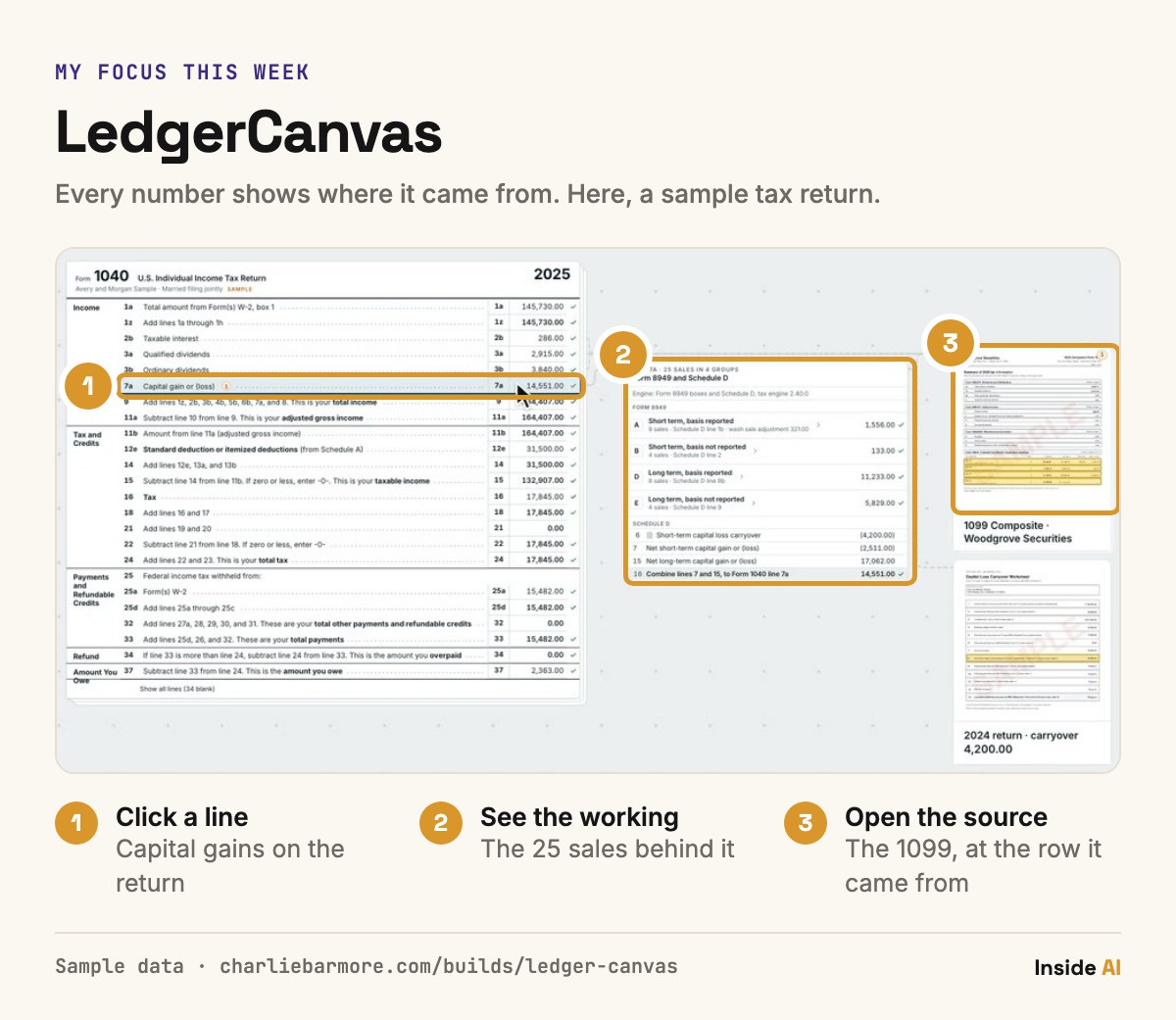
Most of my week went into working on LedgerCanvas. It's something I'm building with Claude and Codex. It's basically a canvas where every number or claim in a document shows where it came from. A memo, a set of financial statements, a research note, a tax return: click a line and the working behind it comes out beside it, along with the source, open to the exact spot. A clause in a lease, a row in a spreadsheet, a line on a bank statement. See the demos
More to read and watch
Try it now
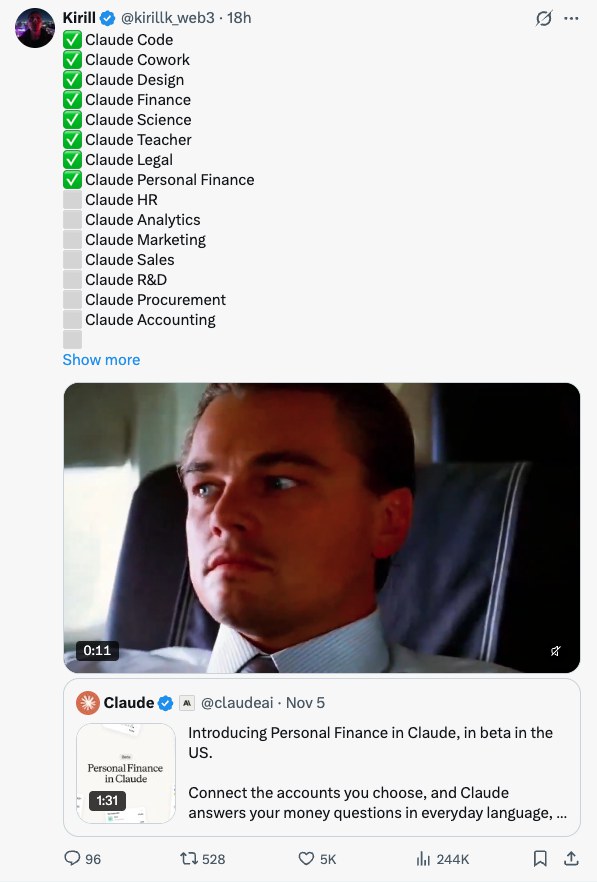
- Claude can now answer questions about your own money. Personal Finance connects your bank and card accounts through Plaid. It's read-only: Claude sees balances and up to two years of transactions, but it can't move, manage or invest anything. Rolling out in beta to Pro, Max and Ultra users in the U.S. this week, and Anthropic says those chats aren't used to train its models.
- Perplexity's "Teammates" take on ongoing jobs for you. They remember project goals and past work, use your connected apps like Slack and Gmail, pass work to each other, and bring finished work back for you to review. Perplexity's examples include a marketing, sales, support or operations teammate. Max subscribers only, on the web for now.
- ChatGPT can now make GIFs. OpenAI's Images 2.6 (Nov 4) turns a picture into a short looping GIF, like a waving mascot or a product shot that moves. OpenAI says it's on every ChatGPT subscription tier. The "50% faster" claim is OpenAI's own.
- Gemini lets you edit documents, PDFs and spreadsheets right in the chat. Ask for a doc, deck, sheet or PDF, then type your own edits or highlight a section and ask for changes. Open to all users (Oct 29). PDFs work on web and mobile, everything else on the web only.
- Turn a sketch on paper into a working app. Draw a habit tracker or an order form, snap a photo, upload it to Gemini, pick Canvas and ask "Can you code this app?" (Nov 5). A quick way to see if an idea works before you pay anyone to build it.
- Google Vids now makes 15-second AI video clips. Up from 10 seconds, and Google says it's no extra cost with a Google account or Workspace (Nov 5). Long enough for a short product explainer or a social ad.
- Free AI training for veteran and military-spouse business owners, Monday Nov 9. A Grow with Google livestream at 1 p.m. Eastern, with a free 30-minute one-on-one coaching session afterward. Register at goo.gle/NVSBW26.
Stay safe
- A two-minute check on who can get into your Gmail. Google's Security Checkup: review signed-in devices, remove old third-party apps, confirm your recovery info. With more AI tools asking to connect to your email, do it on your business account too.
- One shared ChatGPT link was enough to take over an account. Researchers at Parameter Labs found that just opening a malicious share link could expose your private chats. OpenAI fixed it October 26. Nothing to do now, but treat shared AI links like any other link.
- Check whether an image, video or audio clip was made with AI. Google's October roundup is a good catch-up read. The most useful part is SynthID Detector, where anyone can upload a file. It only recognizes content from Google and its partners, so a "no" doesn't prove a person made it.
- ChatGPT is tightening limits for teens and adding parent alerts. Less information on weapons and security systems for under-18s, and chats that fixate on violence can be ended. Rolling out over the next few weeks, so not all live yet.
How others are using it
- How a property company uses AI across one whole process. Heimstaden, a European landlord, uses it for pricing, listing checks and market feedback, with staff approving the decisions. OpenAI wrote this case study about its own customer, so read the numbers as claims.
- An engineer writes a personal "AI policy." Ben Stolovitz looks back on a year of using AI, drafts rules for when he will and won't use it, and is honest about how tiring it is to manage several agents at once. The policy idea works for anyone.
- The Census Bureau now asks businesses whether they use "Super Intelligence." Since October 19, its survey says "Super Intelligence (formerly referred to as Artificial Intelligence)." Simon Willison charted the data: by his math, about 40% of companies with 250 or more employees say they use it.
- Cult.fit's non-engineering teams built 20+ internal apps. The fitness company's HR team, for one, built its own workflow in Codex for performance reviews, scheduling and feedback. What made it work was support: leaders spent a day building something for their own job, engineering holds office hours twice a week, and engineers sit inside some teams. OpenAI wrote this case study about its own customer.
- A "dinner bot" that plans customer dinners. Merge CEO Shensi Ding uses one to pull guests from the company's sales records, check past invitations, keep the attendee list and propose seating. Merge says that prep went from dozens of hours across the company to about 30 minutes per event. Her team still hosts the dinners. Another OpenAI customer story, so the numbers are Merge's.
Where it's headed
- OpenAI built a test of everyday chores. LifeVal covers things like enrolling a child in kindergarten, finding a home or planning meals after a diagnosis. It shows where ChatGPT is headed: from answering questions to running errands. The scores are OpenAI grading itself.
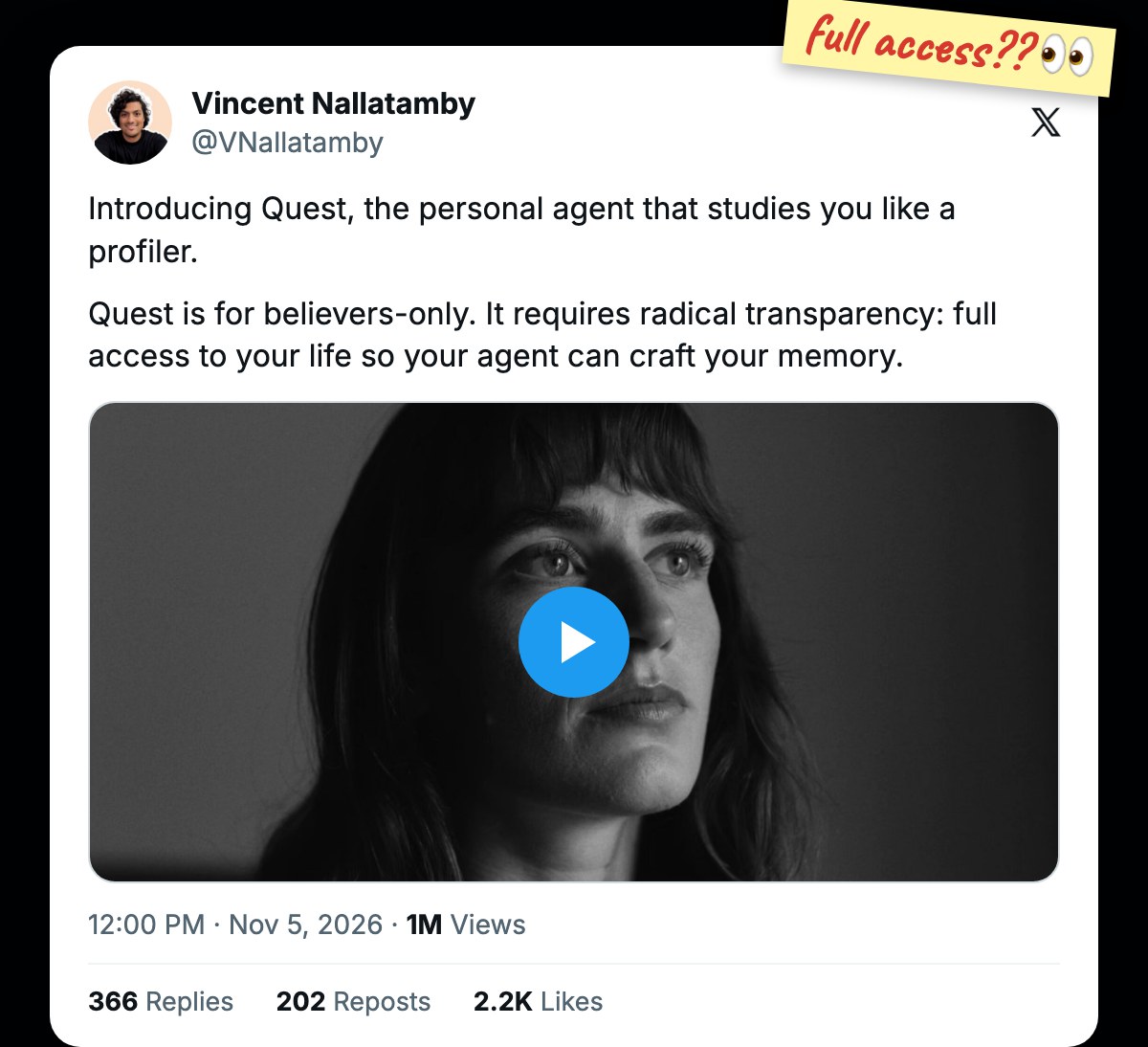
- A personal agent that studies you like a profiler. Quest, launched on X this week by Vincent Nallatamby, asks for full access to your life. In return, it says it builds 100+ files on you and maps your relationships, runs its own Android phone to use WhatsApp, Instagram and TikTok for you, and can manage other personal agents like Instinct and Meta's Muse. Those are the company's claims from a launch video, but it shows where personal agents are going, and it's a good prompt to decide how much of your life you'd actually hand one.
- Visa's CEO says AI shopping agents are still "very early." On Visa's earnings call, Ryan McInerney said purchases made by AI agents are still tiny next to the rest of Visa's business and won't move its 2027 results, even with nearly 50 AI partners live. One early tester on X was blunter: it "basically does not work at all" for her. Let agents compare prices for now, and do the buying yourself.
- OpenAI rewrote the rulebook for how ChatGPT should behave. The new Model Spec is built on five values, including honesty and helping you make your own decisions. OpenAI says its models "do not yet fully reflect it," so read it as a goal.
- Google's AI tutor is now in Google Classroom. Teachers anywhere can assign Guided Learning, which walks a student through a problem instead of handing over the answer. Gemini stays off for K-12 student accounts until a school turns it on. If you're a parent, ask your school what they're turning on.
- One opt-out to keep your website out of AI training. Google, Microsoft, OpenAI and Anthropic agreed to honor one shared signal in your site's robots.txt file, instead of making you block each company by name. Microsoft starts honoring it February 1, 2027, and Google plans to in 2027. The catch, in Google's own post: use it without a Google-specific rule and Google treats it as blocking its Gemini AI too. (Microsoft's post)
Enjoy the weekend, try something new, and hit reply to tell me how it went.
Charlie
Charlie Barmore, CPA, CFE, CVA · CPA and builder exploring how AI agents can help us live and work. charliebarmore.com · Follow on X @cbarmorecpa