Inside AI #2
Hey everyone,
This week brought two impressive model releases, Anthropic's Fable 5.2 and Google's Gemini 4 Carbon. Claude also started joining meetings, and Granola began giving other agents a daily picture of your work. OpenAI opened a place for businesses in ChatGPT, while a16z laid out its case for an economy where agents choose products and services for us. And Nvidia announced that Jensen Huang had stepped down as CEO.
Also below: an AI-built archive of military decisions, a store owner checking his product pages, a law firm insuring its agents, and T3 Work, the app I'm building for myself.
Let's dive into it.
Two impressive model releases: Fable 5.2 and Gemini 4 Carbon
Anthropic released Claude Fable 5.2 on November 9, and Google opened Gemini 4 Carbon to more users on November 10. Both companies position these models for demanding work that takes time: difficult coding, technical research, and projects that require an agent to keep working, checking and fixing along the way.
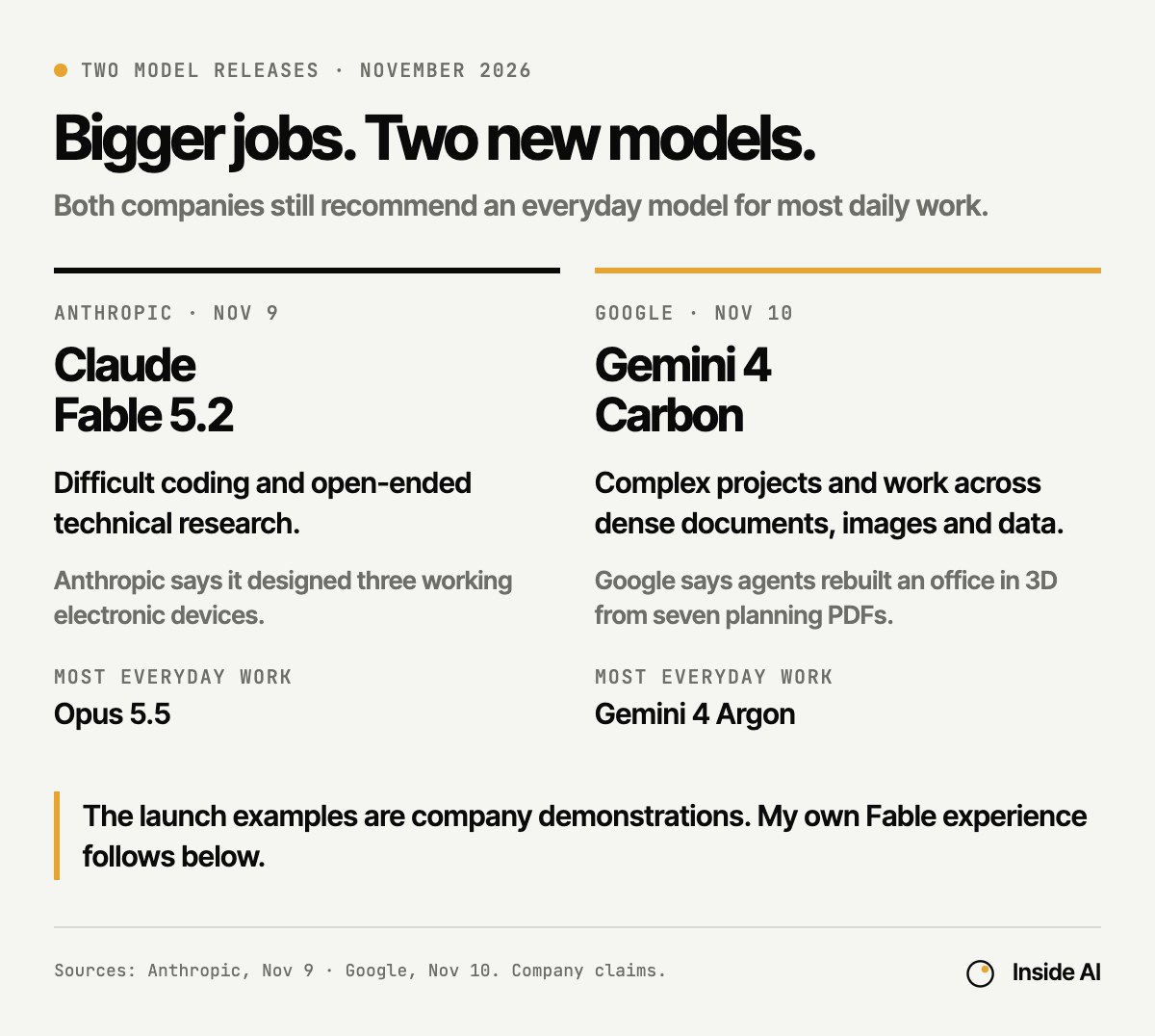
One example from Anthropic's testing: Fable designed a home voice hub, a USB speakerphone and a handheld virtual pet. It selected components, designed circuit boards and enclosures, and wrote the software. Diode manufactured the boards, and Anthropic says all three devices worked without electrical modifications. Yes, it's a vendor-reported test, but it gives a more tangible picture of the release than another benchmark ranking.
Fable and Mythos share an underlying model, with different safeguards and access requirements. Mythos requires verification for qualifying cybersecurity or life-sciences work.
Google emphasizes Carbon's work across dense documents, charts, images and tables, turning that material into spreadsheets, presentations and reports. In one demonstration, Google says a team of Carbon agents built a 3D reconstruction of an office from seven planning PDFs. Carbon is rolling out to Google AI Ultra subscribers in the Gemini app, with paid API access available separately. Google still recommends Argon for most coding and knowledge work, reserving Carbon for the harder jobs.
I've used Fable 5.2 every day since it came out, and I've already changed how I use it. At first, I used it to do everything: building, reviewing, fixing and everything in between. It's very good, but it burns through usage fast. Opus 5.5 still does very well for the majority of the tasks that I do, with less usage.
So now I primarily save Fable 5.2 for one job: when I can't quite explain what I want. Its real strength appears to be figuring out what you're trying to accomplish without you spelling it out. This week I dumped a messy description of a problem on it: I kept losing track of side projects while working with agents. It came back with a two-page design that named the problem better than I had, with a build order to go with it. And this was after multiple failed rounds with Opus 5.5.
So, day to day, I'm back on Opus 5.5 for most work and Fable is my second set of eyes when I'm stuck. Anthropic's own advice matches this too: start with Opus, and switch when the job calls for it.
Your agents are getting more of the background
Last week I wrote about using one Notion workspace for my agents. Several products this week are working on related problems: getting AI into the conversation, giving it the background, and keeping track of what it's doing.
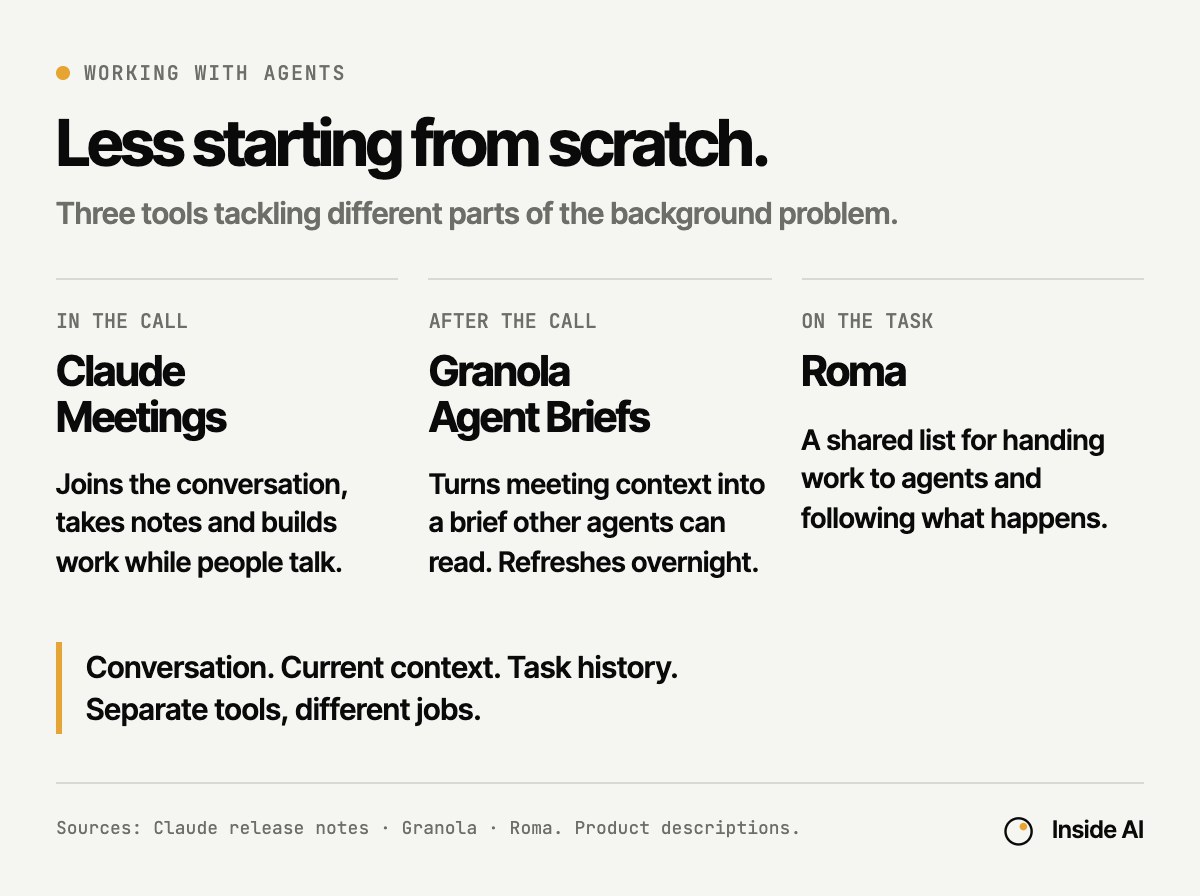
Claude Meetings is rolling out in beta on Team and Enterprise plans. Claude joins a Google Meet call as a visible participant, takes notes, answers questions, and builds documents or whiteboards while people are talking. That arrives alongside Claude Sheets, Whiteboards and Data, which let teams work with Claude on spreadsheets, plans and dashboards.
Granola Agent Briefs takes the background from your meetings and turns it into a brief for your other agents. It covers your priorities, projects, people and communication style, and refreshes overnight. You can connect Claude, ChatGPT and other tools to read it. It's available on Granola's Business and Enterprise plans.
Roma is working on the task side. Its shared list lets you hand off work to different agents and follow what happens in one place. I haven't tested it yet.
These tools do different jobs, but they all touch the time spent bringing AI up to speed. A meeting transcript, a current project brief and a task history give it something more useful to work from than another conversation starting from scratch.
The B2A economy: your next customer might be an agent
In Welcome to the B2A Economy, a16z's Olivia and Justine Moore describe businesses competing to be chosen by AI agents. B2A means business-to-agent. Their argument is that agents will increasingly compare products, choose services and make purchases for the people using them.
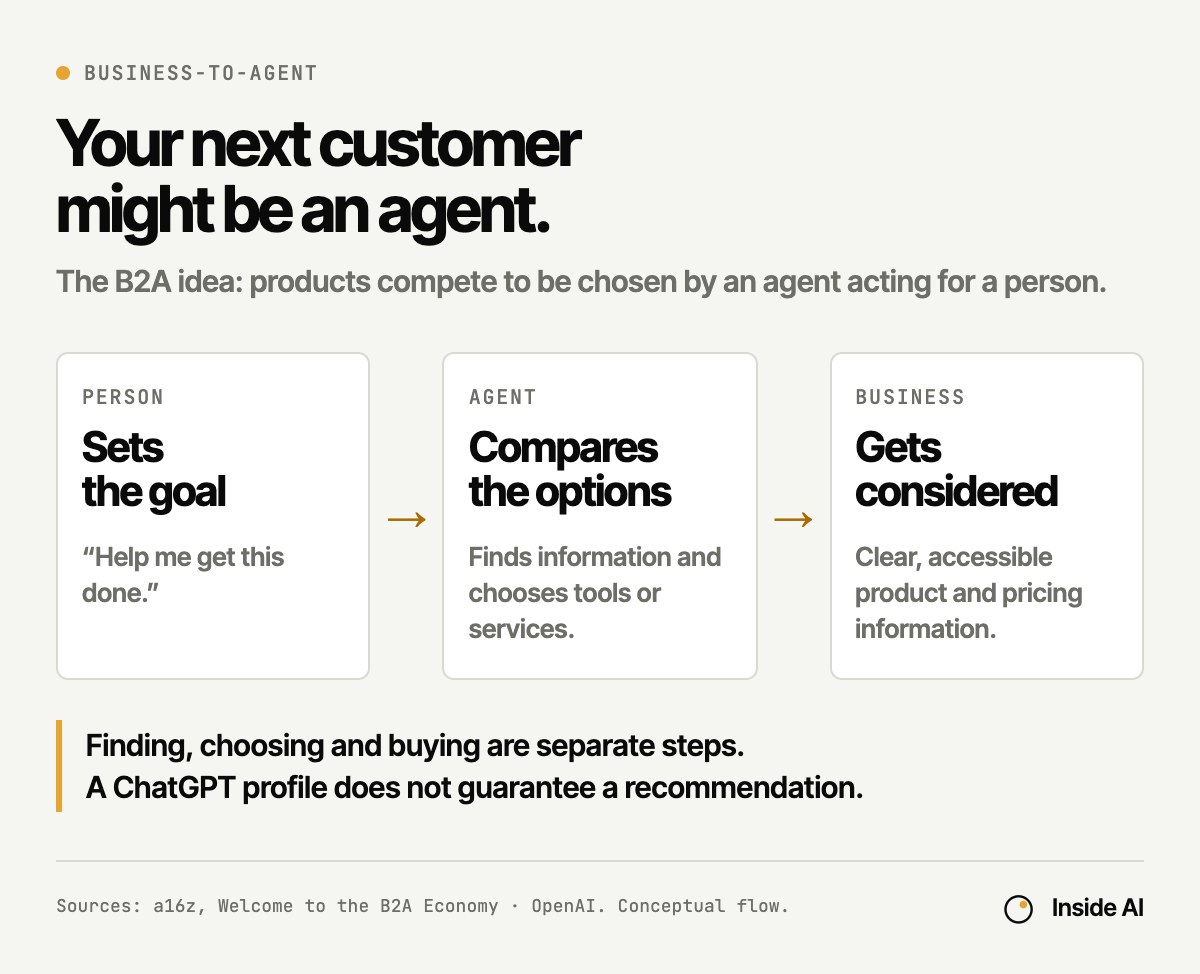
The authors describe asking ChatGPT to make and edit a video ad using Krea, Descript and ElevenLabs. The agent coordinated across the products and prompted them to buy a Descript plan to finish the job. That's their reported example, but the question it raises is practical: when an agent is doing the work, what makes it choose one product over another?
Businesses in ChatGPT is one part of that picture. The beta lets eligible businesses claim and verify a profile, update their information and see aggregated insights. Business Agents, which answer customer questions about a business's offerings, start with eligible ecommerce and online service businesses in the US. A profile doesn't guarantee a recommendation.
There's another concrete example in Latent Space's interview with Resend founder Zeno Rocha. Resend has an interactive pricing calculator for people and a plain-text pricing table that agents can read directly. The information has to be accessible to whoever is doing the comparison.
There are limits to where agents can act, too. United is restricting unauthorized personal agents from its booking systems, Reuters reports. Finding a product, choosing it and completing the purchase are still separate steps.
Jensen Huang steps down at Nvidia
On November 12, Nvidia announced that Jensen Huang had resigned as president, CEO and a board member, effective immediately. CFO Colette Kress is interim CEO and will keep her finance role while the board searches for a permanent successor.
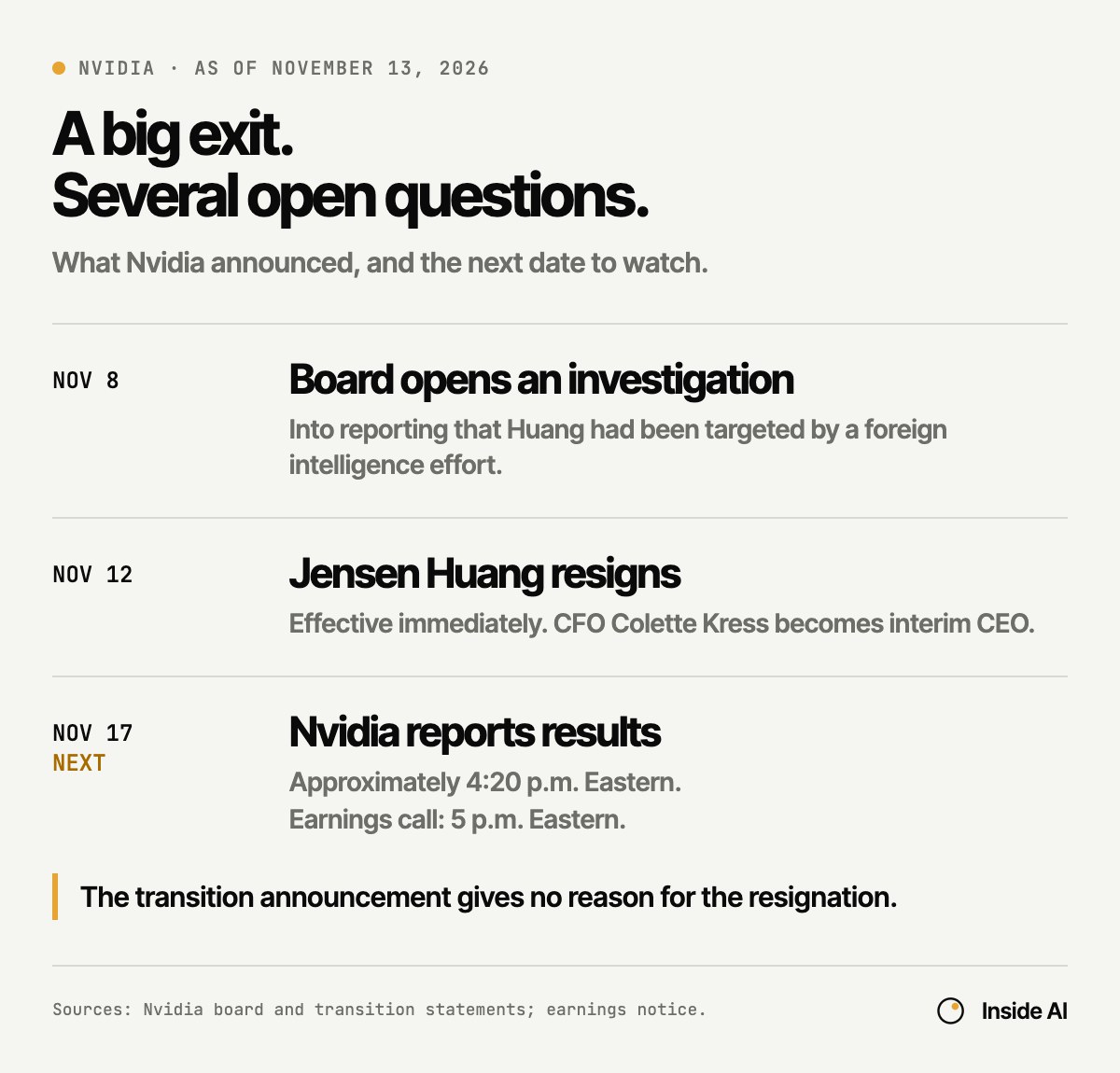
The announcement followed the board's November 8 decision to open an independent investigation into reporting that Huang had been targeted by a foreign intelligence effort. The transition announcement gives no reason for his resignation. Nvidia says it expects operations, customer commitments and its product roadmap to continue without interruption.
My hunch is there might be something deeper going on here, and I've been having fun with it. I keep wondering if this turns into a reason to put more rules around AI, especially the models you can download and run on your own computer. I'm not claiming anyone planned anything. I just had my research desk dig in, then asked it for the tin-foil versions too and had it score each theory on how much evidence it actually had.
What came back cuts both ways. Nvidia has publicly backed downloadable models and signed a letter in July opposing bans on them. But on November 12, three House committee chairs pointed to this situation to push four chip-control bills. Those are about chips and foreign access, not running AI at home, so there's still a big gap between that and my theory. Nvidia reports next week, and Anthropic expects to price its IPO the day after, so I'll be watching both.
One date to watch: Nvidia releases results on November 17 at approximately 4:20 p.m. Eastern, followed by its earnings call at 5 p.m. Eastern.
People doing real work with AI
A store owner catches conflicting product instructions
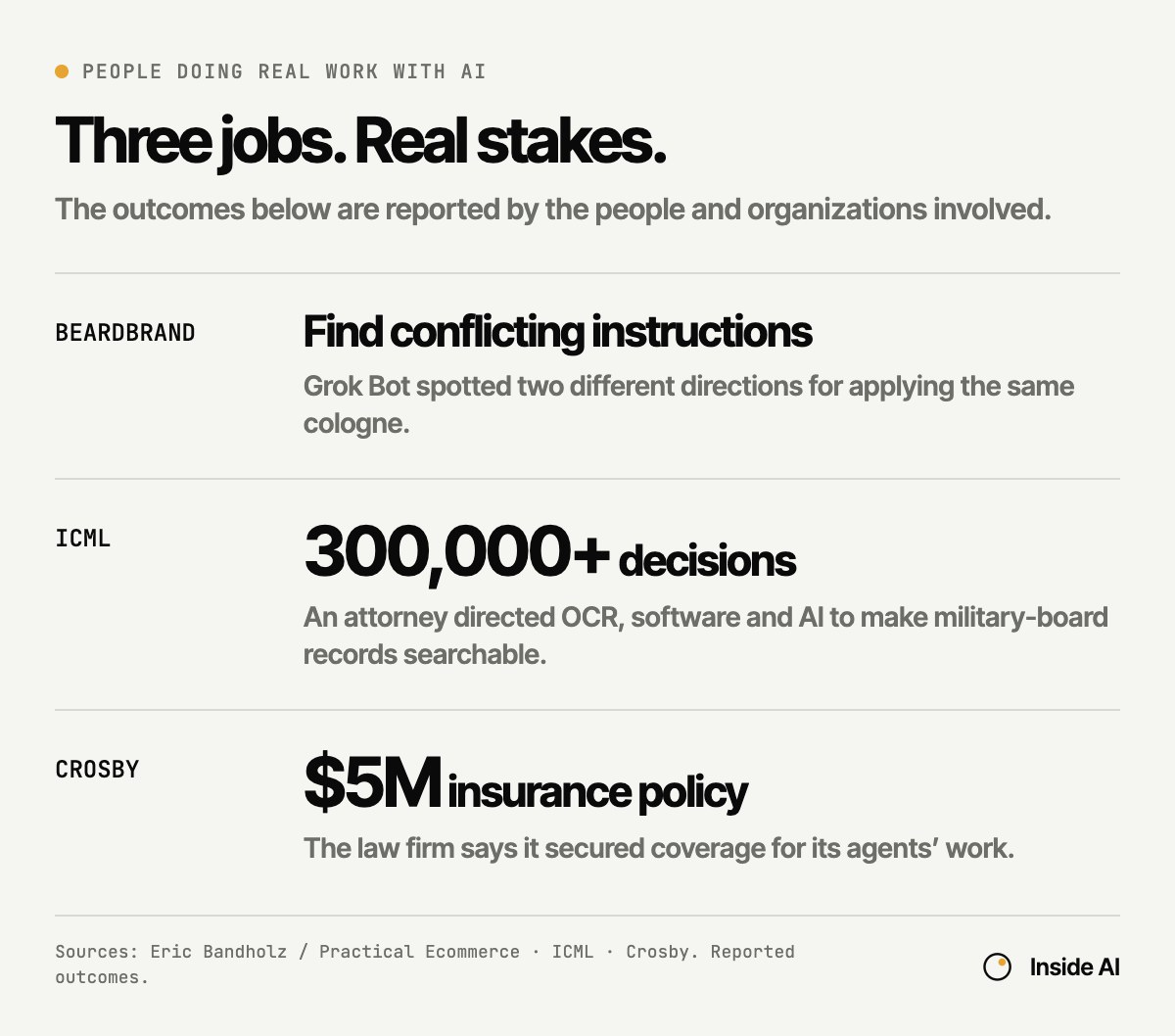
Beardbrand founder Eric Bandholz says he uses Grok Bot to check his store's content. It found one section telling customers to apply a cologne to two to four pulse points, while another said two to six.
It's a specific job with something the owner can inspect: two published instructions disagree. Someone still has to decide which instruction is right, but the AI found the inconsistency.
An attorney helps make 300,000 decisions searchable
The Institute for Constitutional Military Law describes an attorney directing custom software, optical character recognition and several AI systems over many days to build a searchable collection of more than 300,000 military-board decisions.
The original files included scanned pages and documents that were difficult to search. The Institute says its collection turns them into searchable text and links back to the government's copies.
The work combined a professional's subject knowledge with tools that could process a large collection of material.
A law firm buys coverage for its agents
Crosby says it secured a $5 million insurance policy covering its agents' work. When the policy took effect, it removed lawyer review from tasks it describes as paralegal work, about 20% of the work its lawyers previously did.
The firm says the insurer examined its systems, controls and review records before issuing the policy. Its account covers both the work agents do and how the firm handles responsibility for mistakes.
Ways to use AI: 165 documented cases and counting.
My focus this week: T3 Work
Most of my week went into an app I'm building for myself called T3 Work. It started from T3 Code, the app I use to run several AI agents at once. I love it, but it's built for developers: terminal output, code branches, technical settings everywhere. I wanted the same power without having to think like an engineer.
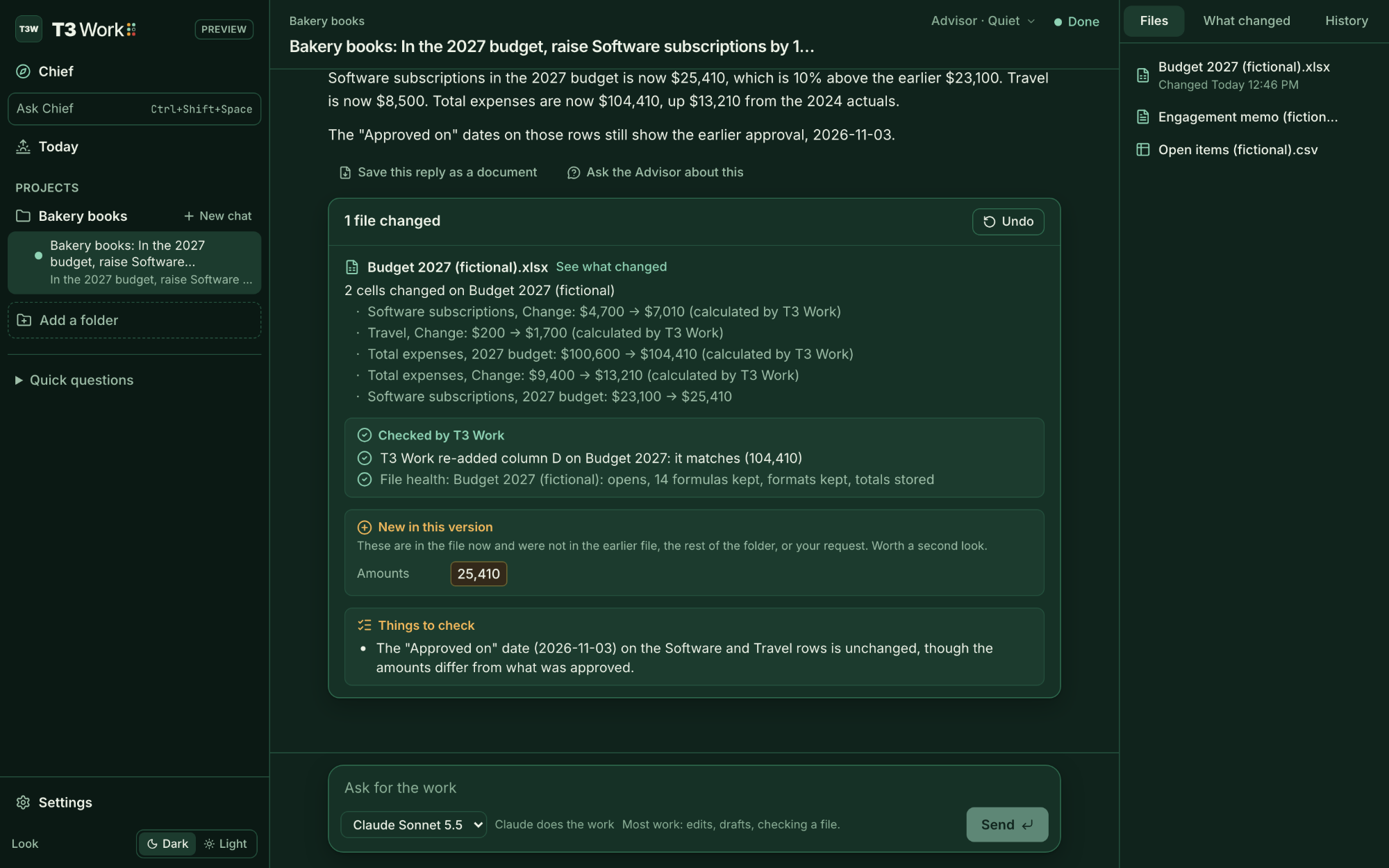
So T3 Work is my version for people like me. You point it at a folder, ask for the work in plain words, and the agent does it. Claude or Codex, on the subscriptions I already pay for. What I changed:
- Every reply ends with a card, like the one in the picture. It shows what changed, down to the exact cells, what the app checked on its own, and what I should double-check myself. In this one, it caught that the budget rows still showed an approval date from before the change.
- A saved version before every reply, so one click undoes anything.
- Plain-English steps instead of terminal output.
- A "Chief" at the top I can throw anything at. One-off questions, ideas I don't want to lose, new projects. It sorts them, keeps a list of what's waiting on me, and starts new work only when I press Go.
The Chief came straight out of a bad habit of mine. I'd be heads-down on one thing, get distracted by another, and lose track of both. This week I pasted in a message, a few screenshots and a meeting transcript, and asked it to set up a project to prep for a meeting. It made the folder, sorted the files, wrote a "start here" guide and lined up the first task. That's the job I want it to do for me every day.
It's not for sale. It's just how I want to work. But if you've ever opened an AI coding tool and felt like it wasn't built for you, this is my attempt at fixing that for myself.
More to explore
- Claude brings chat and Cowork together for Team plans. A conversation can move from a quick question into cloud-based work with files and code. Team owners can enable it now. For eligible organizations, it turns on by default December 1 unless kept disabled; the separate experience retires February 1, 2027. The migration guide covers settings, exceptions and usage costs.
- Nod, n8n's open-source personal agent. A separate Mac and Windows app from n8n Labs that works in connected apps and websites using the AI provider you choose. It's a research preview, rather than an n8n workflow you have to build.
- Grok Bot 1.0 for teams. Shared bots can work in Slack and Microsoft Teams, join video calls and draw on the team's context. Team Bots require Team or Enterprise; meetings are also available on Ultra.
- Gemini Live comes to Apple CarPlay. Google is bringing its voice conversations to CarPlay, with conversations continuing on your iPhone afterward. Availability depends on supported Live languages and app setup.
- Railway's account of its October attack. The hosting company says attackers targeted credentials for AI services. Its report explains what happened and how it responded.
- Notion's Fireworks incident update. Notion says a vendor incident exposed AI chat transcripts used for its Insights feature in fewer than 1% of workspaces. Its advisory explains the scope, customer notifications and ongoing investigation.
- Apple's reported Harbor app. AppleInsider reports that Harbor would turn a Mac into a local AI server and pool memory across compatible Macs. It's reportedly in private preview under Claris, rather than a public app you can download now.
- Adobe is opening creative apps to outside agents. Adobe previewed connections for agents to work in editable creative projects. Those integrations are planned for early 2027.
Two free courses inside AI Outsiders
I've added two free courses to AI Outsiders:
- Local AI Explained: what local models are, what the hardware terms mean, and what to consider when running AI on your own computer.
- AI Agents Explained: how agents use tools, what they can do, and where you decide how much they can do on their own.
Both are in the community's Products tab. If you haven't joined yet, join AI Outsiders here. The community is free, and it's where Inside AI readers can share what they're trying and figure things out together.
Enjoy the weekend, build something cool, and hit reply to tell me how it went.
Charlie
CPA and builder exploring how AI agents can help us live and work. Find me on X or see what I'm building.