Inside AI #3
Hey everyone,
Google shipped so much in the last ten days that it made me rethink how much I've been sleeping on them, the company behind Claude went public (and one of its mathematicians claimed Claude helped prove math's biggest open problem), a run of big outages had everyone wondering if we're under attack, OpenAI admitted its new models sometimes leave out what blocked them, and I ran six frontier models head to head on six business-owner jobs.
Let's get into it.
Google just made it hard to keep sleeping on them
I think most of us can agree that Google has been slept on in the AI race. I know I have barely used their models over the past year. But after the last ten days, I think Google really solidified itself as a serious player alongside OpenAI and Anthropic.

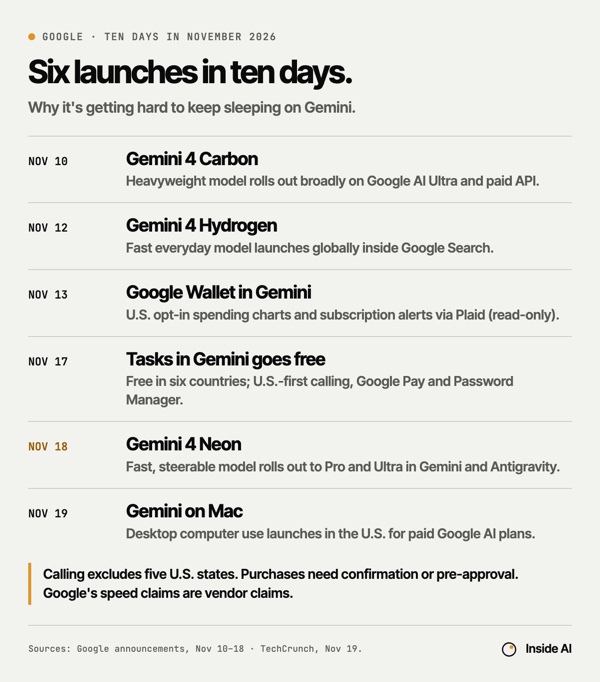
Start with the models. In a little over a week, Google rolled out three distinct Gemini 4 releases: Carbon on November 10 for heavy, extended projects (on Google AI Ultra and the paid API), Hydrogen on November 12 as their fast everyday model that now runs Google Search globally, and then on Wednesday, Gemini 4 Neon, rolling out to Pro and Ultra subscribers in the Gemini app and in Google Antigravity.
Google positions Neon for faster end-to-end work on spreadsheets, PDFs, photos and multi-step jobs, and calls out steerability, meaning how cleanly it adapts when you correct it mid-task. Those speed, cost and benchmark numbers are Google's own claims and benchmark scores, not a guarantee it beats your current tool on everything. That said, I've been working with Gemini 4 Neon myself, and honestly it's been really pleasant to use and work with.
What makes this week bigger than a model drop is everything Google shipped around it:
- Tasks in Gemini is now free. Starting November 17, Google made Tasks free in the U.S., Canada, Japan, Korea, Australia and India, powered by Hydrogen. Flip the toggle from Chat to Task to hand off a job. In the U.S., Google also added calling businesses, paying through Google Pay and signing into accounts through Google Password Manager. The catches: calling isn't available in Indiana, Louisiana, Minnesota, Montana or Nebraska, and Google says purchases need your confirmation or pre-approval, so read carefully before granting any ongoing permission.
- Google Wallet connects to Gemini. On November 13, Google let U.S. users on web and mobile opt in to connect Google Wallet (with optional bank and credit-card linking through Plaid). Tag
@Google Walletto chart spending or flag forgotten subscriptions and price hikes. It's read-only, so Gemini can't move or invest your money, though you are still sharing your spending history to get those answers. - And more in the same stretch. Google also rolled out Gemini desktop computer use on Mac (paid U.S. plans), a "make me a site" feature in Gemini Notebook, and updated history and training controls. Those links are down in More to read.
This is where I think a lot of us start feeling the difference between asking AI a question and handing something off, especially if your email, calendar, files and cards already live in Google. Finding three repair shops is useful. Checking which one has the part and an open appointment is a much bigger chunk of the job.
If you haven't checked in on Gemini lately, you don't need to move your whole setup over. Try Tasks on a small research job with a clear stopping point: compare three local options, show the sources, and don't call, book or buy anything. If you already pay for Gemini Pro or Ultra, run Neon side by side on one task you repeat every week and see how it feels.
OpenAI is moving in the same direction with ChatGPT Wallet, available first through dots, its always-on agents, for ChatGPT Pro subscribers in the U.S. Reports say each purchase needs a security check such as Face ID. We haven't tested Tasks, Wallet or ChatGPT Wallet yet.
The company behind Claude is now public
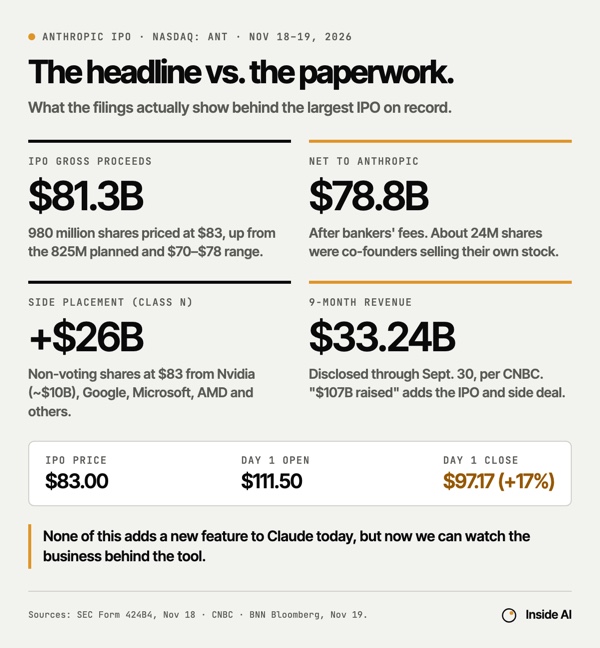
Anthropic priced its IPO Wednesday night at $83 a share, above the $70 to $78 range it had marketed. It sold 980 million shares, up from the 825 million it planned, for $81.3 billion. CNBC calls it the largest IPO on record, ahead of SpaceX's in June. Final prospectus · CNBC
The stock started trading Thursday under ANT. It didn't trade until close to noon, opened at $111.50 and closed the day at $97.17, about 17% above the IPO price. BNN Bloomberg
Two things in the paperwork that the headlines skip:
- About 24 million of those shares were the co-founders selling their own stock. Anthropic doesn't get that money. After the bankers' fee, Anthropic itself takes in about $78.8 billion.
- Seven companies, including Nvidia, Google, Microsoft and AMD, agreed to buy another $26 billion of a non-voting class of stock at the same $83 price, closing right after the IPO. Nvidia's share is about $10 billion. So when you see "$107 billion raised," that's the IPO plus this side deal added together.
I think the useful part for those of us who use Claude every day is that we now get a real look at the business we're depending on. CNBC reports Anthropic disclosed $33.24 billion in revenue for the first nine months of the year. None of this gives your subscription a new feature. But if AI is becoming part of how your business runs, the company behind it is worth watching alongside the tool.
Help me review my dependence on AI tools. Here's what I use each one for: [list]. Identify the workflows that would be hardest to move, what files or instructions I'd need to keep, and a small fallback test I could run without connecting accounts or sharing confidential data. Separate known facts from things I need to check.
Check current export options and plan terms yourself. AI can easily describe an option your account doesn't have.
An Anthropic mathematician says he and Claude proved math's biggest open problem
Just when it looked like Anthropic's IPO was their biggest headline of the week, Friday morning brought a wilder one. Levent Alpöge, a number theorist on Anthropic's technical staff, posted a four-page note saying he believes he and Claude discovered a proof of the Riemann Hypothesis, a 167-year-old problem about prime numbers that is widely considered the most famous unsolved question in math. Alpöge's note
The catches matter just as much as the headline. First, no outside mathematicians have verified it yet. Alpöge didn't publish a normal readable paper; a plain-language version Claude generated ran past 250,000 pages, which he called unreadable. Instead, he released the proof as 14 archive files of code written in Lean, a program that checks mathematical logic step by step. Even with Lean, outside experts still have to confirm the files compile cleanly, use no hidden shortcuts and actually prove the real Riemann Hypothesis as stated. Until they do, the problem is still open.
Second, Alpöge is unusually candid about what happened: he guided the direction, Claude outpaced him near the finish line, and he writes that he is sharing the argument before mastering every part of the math himself. He also notes the breakthrough happened late Sunday night, right ahead of Anthropic's IPO week, and that he had to respect a timing constraint after checking with CEO Dario Amodei about when he could announce it.
You don't need to care about prime numbers to see why this is worth watching. Whether this proof holds up or someone finds a flaw next week, it's a real preview of AI producing work so huge and technical that even the expert steering it relies on software checks instead of reading every line. That's the same verification problem showing up in everyday business work, just at an extreme scale.
Seven outages in six days. Was it one attack?
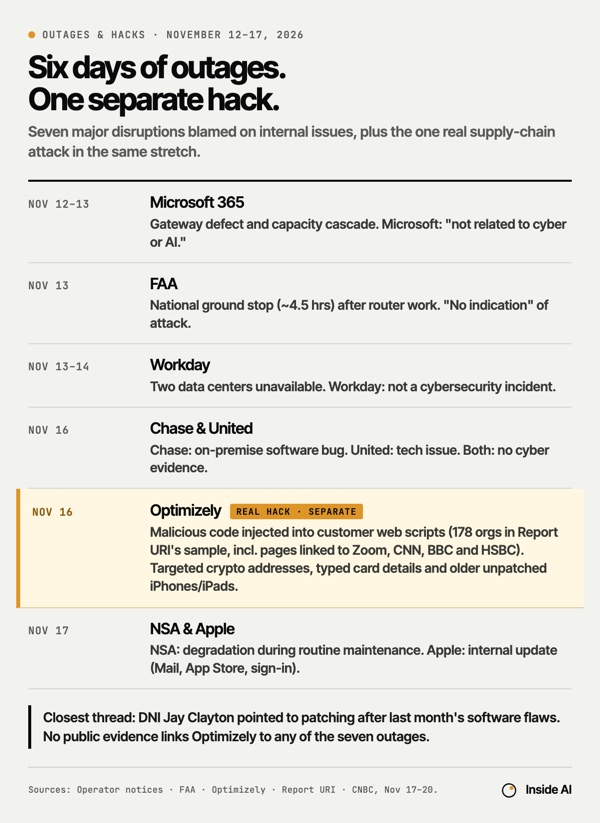
Between November 12 and 17, Microsoft 365, the FAA, Workday, Chase, United, the NSA and Apple all had major problems. I had the same question a lot of you did, so I had my research desk build a timeline of every outage and hack from November 7 to 17. It found 36 stories, and a second AI fact-checked it before I read it. Here is how the six main days shook out:
The short version:
- No public evidence ties the outages to one attacker. Each company blamed something internal: a software bug, an update, maintenance, router work. Most said outright it wasn't a cyberattack.
- The closest thing to a common thread came from the Director of National Intelligence, Jay Clayton. He said a lot of systems were being patched after software flaws that came out last month, and some didn't come back up the way they should have. That's his explanation, not a published investigation.
- Real hacks did happen in the same stretch, separate from the outages. The big one you may have seen online is Optimizely, a tool a lot of companies use to test versions of their web pages. On November 16, someone got malicious code into some customers' pages, and visitors' browsers ran it. Security researcher Scott Helme found altered files tied to 178 organizations in his sample, including pages linked to brands like Zoom, CNN, BBC and HSBC. That's a research sample of altered web scripts, not 178 breached internal networks, and it didn't cause the Microsoft, Chase or Apple outages. Depending on the visitor, the code could swap crypto payment addresses, grab card details typed into the page, or deliver exploit code aimed at older, unpatched iPhones and iPads (researchers haven't confirmed physical device compromises from this attack). Optimizely says it fixed the flaw and removed the code. Optimizely's notice · Report URI
What I'd actually do this week:
- Make sure you can reach your team, customers and vendors if your email or Microsoft or Google login goes down for a day. One phone list outside that system is enough.
- If a payment got delayed, check your bank before sending it again. "Service restored" doesn't mean your payment went through.
- Be careful with "your held messages are ready" emails after an outage. That's exactly when phishing picks up. Log in the way you normally do, not through the link.
- Make sure your iPhone, iPad and browser are up to date. And if your website uses Optimizely or a similar testing tool, ask whoever runs your site what changed and how they know it's clean.
Better files, but check the report
OpenAI released GPT-6.2 Astra and Sol for Plus, Pro, Enterprise and Edu users. OpenAI says they're better at documents, slides and spreadsheets.
The part I'd pay attention to is in the safety report OpenAI published alongside the release. In two of OpenAI's own tests, both models were more likely to leave out the things that blocked their work, like a missing file or a search tool that was turned off. OpenAI says the instructions it gives the models in Codex cut those omissions a lot.
That's OpenAI's own finding, not ours. It's still a good reason to change how you hand work off. Along with the finished file, ask for a short list of the requirements, how each one was met, and anything still blocked.
You can test this without risking real work. Give AI a made-up project brief that mentions an attachment you don't include. Ask for a draft and a completion report, and see whether it names the missing attachment or quietly fills the gap. I'd rather find that habit on a throwaway task than after someone relied on the file.
I tested six AI models on six business-owner jobs
Most early reviews of GPT-6.2 Astra were rough, and OpenAI's own safety report gave us reason to double-check its work. So I didn't expect much when I ran six models (GPT-6.2 Astra, GPT-6.2 Sol, Claude Fable 5.2, Gemini 4 Neon, Gemini 4 Carbon and Claude Opus 5.5) through six everyday jobs for a made-up landscaping company: diagnosing a cash crunch, screening 40 job applicants, pricing services, cleaning up a month of books, clearing a 40-message inbox, and reviewing an equipment lease.
Astra came first with an average of 97.5 out of 100, followed by Sol (95.5), Fable 5.2 (94.9), Neon (92.9), Carbon (91.4) and Opus 5.5 (90.7). On the thing I care about most, not making things up, Astra had 1 verified false or unsupported claim across seven runs and Sol had 2; the other four had between 12 and 23 each. The widest gap was on clearing the inbox (19 points from first to last), where weaker answers put things nobody confirmed into drafts going to customers and suppliers.
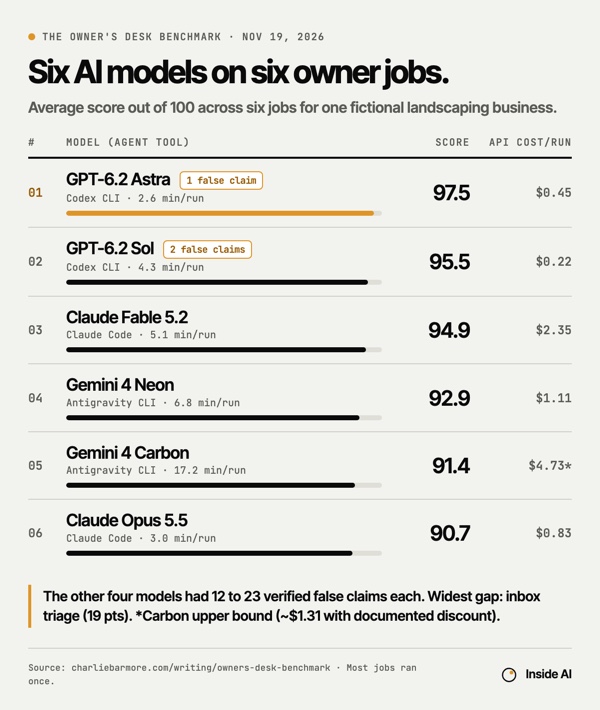
A few honest limits before you switch tools: first to last was only about 7 points, most jobs ran once (repeat runs on the cash job moved by up to 4.5 points), Astra was one of the three blind AI judges, and it's one fictional company. Read the full write-up, job-by-job scores and real mistakes on my site.
I ran the whole benchmark on my monthly subscriptions and tracked what the same work would have cost pay-as-you-go through an API (the pay-per-use connection apps use to call a model): roughly $0.22 a run for Sol and $0.45 for Astra, up to $2.35 for Fable and $4.73 at Carbon's upper bound. Which brings up a question I get a lot: should you pay per use through an API or stick with a monthly plan?
Product leader Paweł Huryn just measured how much monthly usage each major subscription buys compared with public API list prices (his Nov 20 post):
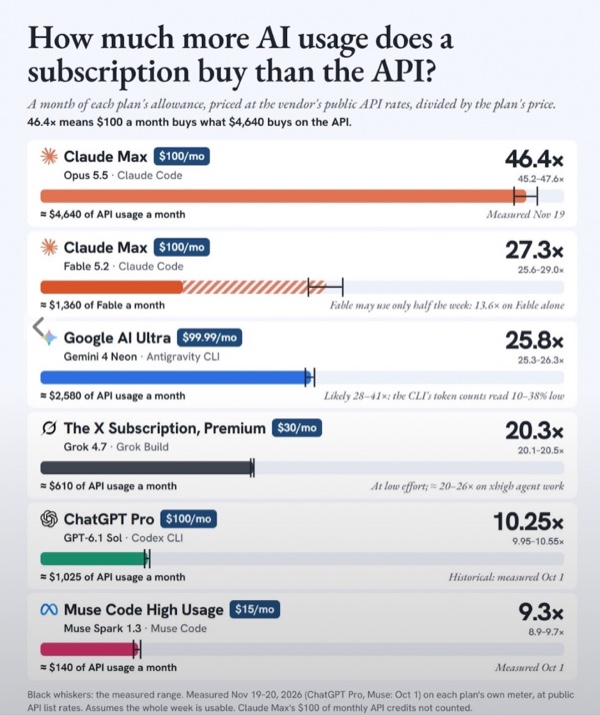
At the top end, $100 a month for Claude Max bought roughly $4,640 of API-priced Opus 5.5 usage (46.4x), and $99.99 for Google AI Ultra bought about $2,580 of Gemini 4 Neon (25.8x). The catches: that's one person's measurement, not vendor numbers; it was measured in coding tools that burn far more tokens than normal chat; the ChatGPT Pro and Muse numbers are from October 1; it assumes you can use the whole week's allowance; and vendors can tighten limits anytime. Still, if you're running heavy workflows and paying API bills out of pocket, compare last month's bill against a flat subscription. For everyday chat, a $20 plan is still plenty.
How people are using it
Chris Savage checks who shouldn't get the email. The Wistia co-founder describes using the company's shared agent to prepare customer outreach on Unchurned episode 218. He describes it checking for existing customer conversations, like an upcoming customer-success meeting, before any outreach goes out. That's a custom setup connected to their systems, but the idea is easy to borrow:
Compare this contact list with these recent-contact and upcoming-meeting tables, matching customer IDs. Apply only these exclusion rules: [rules]. Return Exclude, Eligible, or Needs review, with the supporting row IDs. Flag missing dates. Don't send messages or change records.
Colin Matthews built away a weekly chore. In Peter Yang's interview, he says he built a small image-sizing tool in Replit because his newsletter images kept cropping wrong, and he uses it every week. I like how small the job is: one recurring annoyance, with a result he can check right away.
Saikat Basu asks what his draft actually says. He gave ChatGPT a messy 1,200-word draft and asked for a paragraph-by-paragraph outline of what it said. In his write-up from 2025, he says it showed him a rushed conclusion and examples that needed more detail.
Make a reverse outline of this draft. For each paragraph, give its main point, what it does in the argument, and any structural problem. Don't rewrite it yet. Refer to paragraph numbers.
Quick hits
- AI is moving straight into your books: Three launches landed this week. On November 18, OpenAI rolled out ChatGPT for Accounting with partners like Xero (U.S. first, where you review in ChatGPT and take action back in Xero), and Mercury connected Mercury Books to Claude and ChatGPT. Then on Friday, Grok Bot added Intuit QuickBooks Online in the U.S. (days after SpaceXSI wrote up running five Grok Bots on its own accounting team), letting you ask about cash flow and unpaid balances and draft invoices, estimates and payment reminders for your approval, with per-tool permission toggles. Watch the difference in guardrails: Grok Bot and Xero keep you in the approval step, while Mercury's docs warn that Books changes post to your general ledger immediately with no separate approval in Mercury, so ask AI to show you what it plans to change before it touches anything.
- Hidden instructions still trick AI agents: Security firm PromptArmor released FrontierBreach, a test that plants hidden orders inside emails, files and add-on skills. Across the 21 models it tested, attacks succeeded 34.9% of the time (45.5% through third-party skills), though the newest top models did much better (2.4% on Gemini 4 Carbon, 7.6% on GPT-6 Astra, 10.0% on Claude Fable 5.2). Those are a security vendor's own numbers, not an independent audit, but it's still a good reason to remove skills and plugins you don't recognize before connecting AI to your inbox.
- A downloadable AI model built for a laptop: On Friday, Thinking Machines Lab released Inkling 2 Mini, an open-weights model you can download and run locally instead of renting from the cloud. Its sibling Inkling 2 Small is 594 billion parameters; Inkling 2 Mini shrinks that to 26.4 billion parameters by using a "looped" design that runs its middle layers three times per step, packing more reasoning into a roughly 20GB memory footprint. Thinking Machines says it leads open-weights models under 100 billion parameters on coding and reasoning tests (and posted a 20.1 score on the Artificial Analysis Index on X). The catches: a 20GB footprint still needs a higher-memory laptop (a base 8GB or 16GB machine won't fit it), those are the company's own reported numbers for a small local model (well below top cloud models), and setting up local models still takes technical work. You don't need to install it today, but it shows how fast offline AI is shrinking toward laptops people already own.
- Nvidia after Jensen Huang: In its first earnings report since Huang left, Nvidia kept promoting open models you can download and run on your own machine, and the board said it doesn't plan to bring him back as CEO. CNBC
- A new chip rule, not a ban on local AI: Commerce's new rule, scheduled to publish November 19, tightens foreign access to big computing power. It also formally removes older controls on model files that were never enforced. The bills that would restrict owning certain models target "superintelligence" and are sitting in committee.
- Ways to use AI: 165 and counting. The full library is now live at charliebarmore.com/use-cases. My desk tested five new use cases this week: three worked and two were mixed.
More to read
- Gemini can use your Mac (Nov 19): TechCrunch reports it launched Thursday, in English in the U.S., for paid Google AI subscribers (Plus, Pro or Ultra). It's separate from the free Tasks rollout.
- macOS 27.3 warns before giving AI full Mac control (Nov 16): MacRumors reports Apple's new beta adds clearer warnings about exposing files, mail and messages, splits permissions so you can limit apps to specific folders, and puts an indicator in the menu bar when an app controls another one. It's still in beta, and permissions you already granted stay as they are unless you review them.
- Slack brings AI agents into Workflow Builder (Nov 18): Slack's no-code builder now lets teams hand workflow steps to Slackbot or third-party agents and schedule recurring agent prompts, with a review step before anything goes out. Available on paid plans (Pro, Business+ and Enterprise); external triggers like Calendar and Salesforce are still coming.
- Gemini Notebook can turn your notes into a site (Nov 18): type "make me a site" in Gemini Notebook chat to turn uploaded notes and sources into an interactive dashboard or project tracker you can share. Web only for now, 18+, rolling out over up to 15 days from November 16.
- ChatGPT Live Dictation drops the 10-minute limit (Nov 18): 9to5Mac reports ChatGPT now turns speech into text as you talk and removed the old 10-minute cap, rolling out globally across all plans on mobile, web and desktop. Handy if you prefer talking through rough notes.
- Claude Meetings (Nov 12): a Team and Enterprise beta that builds documents and whiteboards during Google Meet calls. Get everyone's OK before transcribing, and check your plan's guest settings (Team includes outside guests by default; Enterprise doesn't).
- ChatGPT for Sales (Nov 17): a Sales plugin plus more than 30 new or expanded partner plugins for account research, meeting prep and follow-up. What you get depends on your plan, region and workspace settings.
- Gemini's new history and training controls (Nov 16): rolling out in the coming weeks so you can keep your chat history and still opt out of training. Even with history off, Google says it keeps future chats for about two months.
- Read Wallet's checkout wording (checked Nov 19): OpenAI says "Ready to check out" means your approval is done, not that the store placed the order. Look for the store's confirmation before you try again.
- Jeremy Utley on Radical Candor (Nov 10): he uses a meeting transcript (with permission) to ask AI where he did well and where he got in his own way. The coaching example is around six minutes in.
- PostHog's small checks before big AI calls (Nov 9): two narrow checks for personal information let 98.7% of their summaries skip a more expensive rewriting step. That's their production account, not a guarantee the checks catch everything.
- How scientists actually used ChatGPT (Nov 16): OpenAI looked at activity from 1,819 scientists and surveyed 251. The time savings are their own estimates, and OpenAI says the study doesn't prove cause and effect.
Talk soon,
Charlie